


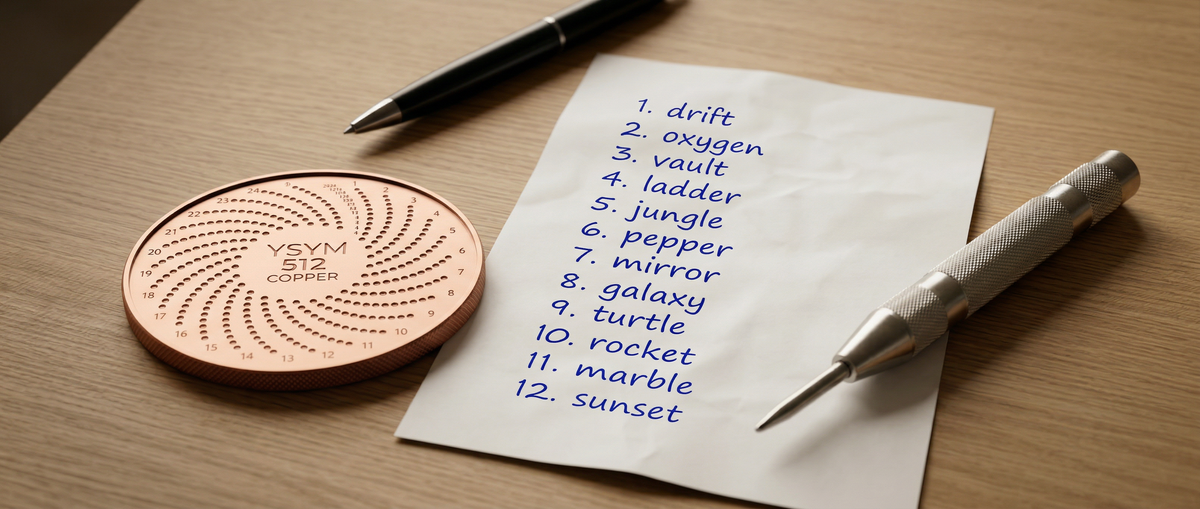
Your seed phrase is the master key to your crypto. It is 12 or 24 words that open your entire holdings to whoever has them, and if they disappear, your holdings go with them. There is no support line, no "forgot my password" and nobody to complain to.
This guide explains exactly what a seed phrase is, how it works under the hood, whether 12 or 24 words is right for you, what a passphrase is and how to store it so it survives fire, water, time and prying eyes.
In short:
- A seed phrase is a list of 12 or 24 words that regenerates every private key in your wallet.
- It follows the BIP39 standard: 2048 possible words, the order matters and the last word contains a checksum.
- 12 words are enough for most people. Real security depends on how you store it, not on how many words it has.
- Never digital: no photos, no notes, no cloud, no password manager.
- Store it on a fire- and water-resistant physical backup, with at least two copies in different places.
- A passphrase (the "25th word") means that even if someone finds your 24 words, they cannot reach your funds.
What is a seed phrase?
A seed phrase (also called a recovery phrase or mnemonic phrase) is a sequence of 12, 18 or 24 words that your wallet generates when you create it. Those words are a human-readable form of a huge random number from which all your private keys and addresses are mathematically derived.
The most important thing to understand: your seed phrase does not live on the blockchain or on any server. It only exists where you wrote it down. Your hardware wallet is just a device that holds it while it works; if it breaks, gets lost or stolen, the words let you restore everything on another device, from the same brand or a different one. Without them, your funds stay on the blockchain, but nobody can ever move them again.
That is why self-custody comes down to one sentence: whoever has the words has the money. Your device PIN or your exchange's two-factor login do not matter: with the seed phrase, everything else is irrelevant.
How a seed phrase works: the BIP39 standard
Almost every modern wallet follows the BIP39 standard, proposed in 2013. Thanks to it, you can create your wallet with one brand and restore it with another without losing anything. The process has four steps:
- Entropy. The wallet generates a random number of 128 bits (for 12 words) or 256 bits (for 24). The quality of this randomness is the foundation of all your security, which is why you should never "make up" your own phrase.
- Checksum. A few check bits calculated with SHA-256 are added to the number. That is why the last word is not free, and why your wallet catches many mistyped phrases.
- Words. The result is cut into 11-bit blocks. Each block is a number from 0 to 2047 that points to a word on the official BIP39 list of 2048 words. The first four letters of every word are unique, so they are enough to identify it.
- Seed and keys. The words (and the passphrase, if you use one) go through the PBKDF2 function with 2048 iterations and produce a 512-bit seed. From it, a tree of keys is derived (the BIP32 standard) that gives you your Bitcoin, Ethereum and any other compatible network addresses.
Two practical consequences: word order matters (swapping two words creates a different wallet) and one phrase controls all your networks and accounts, not just Bitcoin.
12 or 24 words?
A 12-word phrase has 128 bits of entropy: about 3.4 × 1038 possible combinations. Trying them all is beyond any computer, or every computer on Earth combined. A 24-word phrase has 256 bits, an even larger margin.
For the vast majority of people, 12 words are perfectly secure. Nobody is going to guess your phrase: it gets stolen because it is badly stored, or lost because it was on a piece of paper. The difference that matters is not the number of words, but the backup material and where you keep it.
If your wallet gives you 24 words (many hardware wallets do by default), that is fine: you will simply have twice as much to engrave.
Seed phrase vs. private key
They are often confused, but they are not the same. A private key controls one specific address; a seed phrase generates every private key in your wallet.
| Private key | Seed phrase | |
|---|---|---|
| Format | 64 hexadecimal characters | 12 or 24 words |
| Controls | One address | Every address in the wallet |
| Networks | One blockchain | All compatible ones |
| Backup | One copy per key | One copy covers everything |
| Ease of copying | Low, easy to make mistakes | High, with error checking |
To go deeper on keys, see our guide on how to protect your private keys.
The passphrase or "25th word"
A passphrase is an extra word or phrase that you choose and that is combined with your seed phrase. Each different passphrase generates a completely different wallet on top of the same 12 or 24 words.
It is probably the security measure with the best effort-to-protection ratio there is, for a simple reason: if someone finds your plate with the 24 words but does not have the passphrase, they find nothing. They do not even know another wallet exists. It also lets you keep a "decoy" wallet with a small balance without the passphrase, and your real holdings protected behind it.
Three rules to use it well:
- If you forget it, you lose those funds. There is no word list or checksum to help you recover it. Back it up.
- Never in the same place as the seed phrase. If you keep them together, you are back where you started.
- Test before you deposit. Check that phrase + passphrase restores exactly the same addresses.
You do not need complex setups to be secure. A well-stored phrase plus a well-stored passphrase solve the vast majority of real-world incidents.
How to store your seed phrase: methods compared
A good backup has to withstand three threats at once: loss (you forget it, throw it away, move house), destruction (fire, water, time) and theft (someone sees it or finds it).
| Method | Fire | Water and time | Theft and prying eyes | Verdict |
|---|---|---|---|---|
| Photo, phone note, email, cloud, password manager | — | — | Very vulnerable: malware, syncing, leaks | Never |
| Paper in a drawer | Burns at ~230 °C | Ink fades and damp destroys it | Photographed in seconds | Temporary only |
| Laminated paper in a fireproof box | Holds out for a limited time | Better, but degrades | Depends on the box | Not enough long term |
| Metal plate | Withstands house fires (depending on the metal) | Decades without degrading | Depends on where you keep it | The recommended standard |
| Metal + passphrase kept by another route | Same as metal | Same as metal | Whoever finds one piece reaches nothing | What we recommend |
Why digital is the worst mistake
A screenshot syncs to the cloud on its own. A phone note can be read by any app with permissions. A file on your computer is within reach of any malware searching for words like "seed" or "wallet". Encrypting it only adds another point of failure: one more password to forget. The rule is absolute: your seed phrase must only exist on a physical backup.
Why paper is not enough
Paper is not a mistake because it can be hacked, but because it is fragile. A house fire easily exceeds 600 °C, and paper burns at around 230 °C. A leak, a spilled coffee or just a few years in a drawer can leave words unreadable. And it is easy to lose: inside a book you give away, in a house move or during a clear-out. A metal plate removes these problems in one go.
Which metal to choose
Not all metals hold up the same. These are the approximate melting points of the most common materials:
- Copper: about 1,085 °C. Beats most house fires and does not rust like iron.
- 316L stainless steel: about 1,400 °C. The same steel used in marine environments, highly resistant to corrosion and salt water.
- Grade 5 titanium: about 1,600 °C. Light, extremely corrosion-resistant and with the widest thermal margin.
Yoseyomo plates are made in Spain in these three materials: YSYM512 in copper, YSYM1024 in 316L steel and YSYM2048 in grade 5 titanium. All are compatible with BIP39 and SLIP39. Words are stamped with an automatic punch using a numeric cipher rather than readable text, so anyone who glances at the plate cannot read your phrase. They come with tamper-evident seals and a lifetime warranty. The YSYM2048 won a Red Dot award in 2025.
Where to keep your copies
- At least two copies, in geographically separate places: for example, your home and a trusted relative's home in another city. A fire or a flood should not be able to destroy both.
- Discretion over "clever" hiding places: nobody who does not need to know should know that you hold crypto, or where the copy is.
- A bank safe-deposit box, with caveats: it protects against theft, but you depend on opening hours, the bank's policies and access not being blocked. It can be one of your locations, never the only one.
- Never cut the phrase in half. It doubles the risk of losing it (lose one half and you lose everything) and adds no real protection. There is a mathematical way to split it, Shamir (SLIP39), but it multiplies the pieces that can be lost and makes recovery much harder for a non-technical family. For most people, a complete copy in metal plus a passphrase kept by another route is both safer and simpler.
The non-negotiable rules
- Nobody legitimate will ever ask for your seed phrase. Not your wallet's support team, not your exchange, not us. If someone asks for it, it is a scam.
- Never type it into a website or into any app other than your wallet's official one, downloaded from its verified website. Phishing sites and fake apps in app stores are the most common way phrases are stolen.
- Never photograph it or read it aloud, and never handle it with cameras or video calls nearby.
- Let the wallet generate it. Never choose the words yourself or use online generators.
- Buy your hardware wallet only from the manufacturer or official resellers, never second-hand.
For the most common mistakes with examples, see our guide to seed phrase storage mistakes, and for a real case of what carelessness costs, how Manuel lost 44 million in Bitcoin.
Check that your backup works
A backup you have never tested is not a backup, it is a hope. Before moving significant amounts to a new wallet:
- Write the phrase (and the passphrase, if you use one) on your final backup.
- Reset the hardware wallet or use another trusted device and restore the wallet from your backup, not from the screen.
- Check that exactly the same addresses appear as before.
- Send a small amount first, then the rest.
And once a year, physically check your copies: that they are where they should be and that they are readable. You do not need to type them into any device for that.
What to do if your seed phrase has been exposed
If you think someone may have seen or copied your phrase, do not wait to confirm it. Time is against you.
- Create a new wallet with a new phrase, on a clean device (not the one where the leak may have happened).
- Move all your funds immediately, starting with what is worth most, even if fees are high.
- Check every network, not just Bitcoin: the same phrase controls your addresses on Ethereum and any other compatible network.
- Revoke contract approvals if you used DeFi, with a tool such as Revoke.cash.
- Never use that phrase again. Destroy the old copies once the new one is verified.
What if something happens to you?
Your seed phrase solves your access, but not your family's. If nobody knows it exists, where it is or how to use it, your crypto is lost with you. And if you tell them everything today, you lose your security while you are alive. The balance lies in keeping the pieces apart: the phrase engraved in metal, and the passphrase, together with where the plate is, sent by another route that only reaches your family when the time comes. We explain it in how to pass on your seed phrase to your heirs without putting it at risk. For the instructions and messages that should only reach your family when you are gone, there is Inheritans.
Seed phrase FAQ
What happens if I lose my seed phrase?
If you still have access to your wallet, create a new one with its own phrase, store it properly and move your funds now. If you have lost both the phrase and the device, the funds are unrecoverable: they remain on the blockchain, but nobody can move them.
Can I change a wallet's seed phrase?
No. The phrase and the keys are mathematically linked. To get a new phrase you have to create a new wallet and transfer the funds, paying network fees.
Can someone guess my seed phrase?
No. With 2128 combinations or more, brute force is infeasible. Phrases get stolen because they are badly stored, or because someone tricks the owner into typing them into a fake website.
Are a seed phrase and a recovery phrase the same thing?
Yes. Seed phrase, recovery phrase and mnemonic phrase are names for the same concept.
Do all wallets use BIP39?
The vast majority do. The best-known exceptions are Electrum, which uses its own phrase format, and wallets that use Shamir with the SLIP39 standard. Check before assuming you will be able to restore it in another app.
Can I keep it in a password manager?
It is not recommended. A password manager is online and a very valuable target for attackers: if it falls, everything falls at once. Your seed phrase belongs on a physical backup.
What if I wrote a word down wrong?
If the word does not exist on the BIP39 list, the wallet will not accept it. Look up the valid word that starts with the same letters on the list. If it is a valid but wrong word, the wallet will open empty, with different addresses. That is why you should always do a recovery test before depositing funds.
Can I memorise the phrase instead of writing it down?
As a complement, yes; as your only copy, never. Memory fails over time, under stress or through illness, and the day it fails there is no going back. And if it only exists in your head, your family cannot inherit it.
Can quantum computers break my seed phrase?
Today they are not a threat to your seed phrase. With 128 bits of entropy or more, brute force remains infeasible even with the theoretical gains of quantum computing. The quantum debate mainly concerns transaction signatures, and networks will have to adapt long before it becomes a practical risk.
About the author. Iñaki Zubeldia is co-founder of Yoseyomo and Inheritans and author of the Spanish self-custody manual La BUENA autocustodia. He has been in crypto since 2017 and since 2020 has helped people get started safely and with sound risk management. He speaks regularly about individual sovereignty, self-custody and digital inheritance.
Share:
What Is Crypto Self-Custody and How Does It Work
Seed Phrase Storage Mistakes: How to Avoid Them