


Note: we have changed the name and some details of this story to protect the privacy of the people involved.
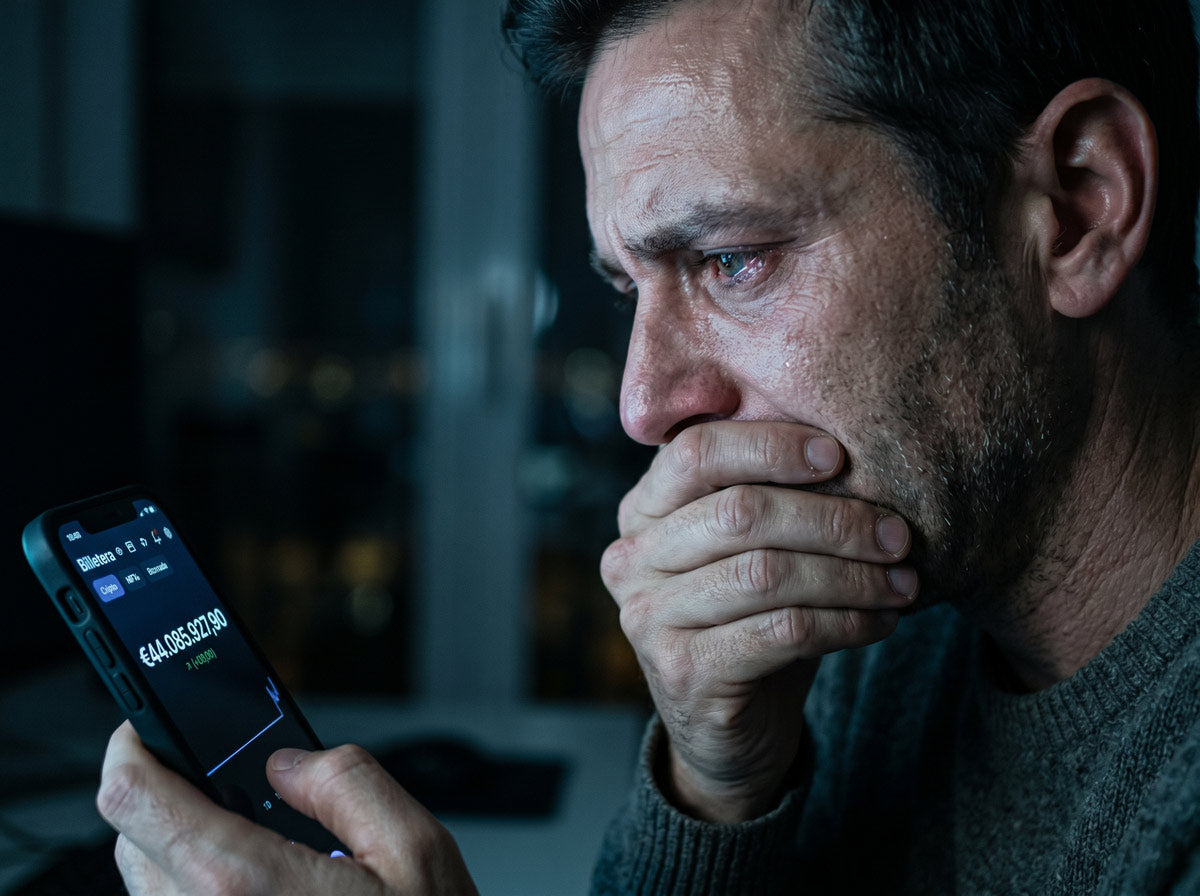
Manuel was an industrial welder from Bilbao. For decades he built his life working with metal, precision and perseverance. But in a single day he lost access to 44 million euros in Bitcoin. Not through a hack. Not through a violent robbery. Simply because he kept his seed phrase and his Ledger wallet in the same box, and he lost that box.
His case shows how poorly planned self-custody can put an entire fortune out of reach. Manuel had the Ledger app on his phone, but without the seed phrase or the physical device he could not sign transactions. His bitcoins are still there, visible, but nobody can move them. Financial sovereignty without knowledge becomes a trap.
Why Manuel's system failed
Manuel made a common mistake among cryptocurrency users: concentrating all his recovery points in one place. The same box held the seed phrase and the hardware wallet. When he lost that box, he lost both ways in at once. There was no second copy of the phrase anywhere else. There was no plan B.
The seed phrase is the master key to your digital assets. If you lose it, you permanently lose access to your funds. If someone finds it, they can take your funds. Manuel thought he was protecting himself against theft by keeping everything together and well hidden, but that left him defenceless against loss.
The Ledger mobile app only lets you view your funds. Without the physical device or the seed phrase, you cannot authorise transfers. Manuel could see his fortune on his phone screen, but he could not touch it. Like looking at treasure behind glass.
The most serious mistakes in self-custody
Many people who self-custody their cryptocurrencies make variations of Manuel's mistake: they leave everything in a single point of failure. Some write their seed phrase on paper and leave it in a drawer, next to the wallet. Others photograph it and upload it to the cloud. Others keep it in a text file on their computer.
Paper burns, gets wet and degrades over time. Ink fades. Photos and digital files get synced, copied and can end up in the hands of anyone who gets into your account or your device. These methods work until they stop working, and by then it is too late.
Manuel's underlying mistake was not technical but one of design. He had a single copy of the seed phrase and kept it alongside the very device that phrase was meant to back up. A backup that lives in the same place as the original is not a backup: it shares the same fate. And without a passphrase kept by another route, he had no way of spreading his copies across different places with peace of mind.
Manuel knew how to weld industrial metal, but nobody had explained to him how to design a resilient custody system. It is not a question of intelligence, but of applied knowledge. Without some basic understanding of self-custody, it is easy to make mistakes that seem sensible.
What a real custody system should look like
A robust self-custody system separates points of failure. Our recommendation is simple: the complete seed phrase engraved in metal and a passphrase kept by another route, never together. Ideally, have at least two copies of the plate in geographically separate places, to withstand local disasters such as a fire or a flood. The seed phrase must never exist in digital form, not even encrypted. We explain this in detail in our guide to the seed phrase and how to safeguard it.
Metal stands up to fire, water and the passage of time far better than paper. For reference, copper melts at around 1,085 °C, 316L stainless steel at around 1,400 °C and grade 5 titanium at around 1,600 °C, whereas a house fire easily exceeds 600 °C. Paper does not survive those conditions.
You should document your system so that your heirs can access the funds if something happens to you, without that documentation compromising your security while you are alive. The passphrase helps: anyone who finds a plate without it gains access to nothing. What matters is that your heirs know where the plates are and how to obtain the passphrase when the time comes. We cover this in our guide to the seed phrase and inheritance.
Periodic checks matter too. Every so often it is worth confirming that your copies are still legible, that the places where you keep them are still secure and that you remember how to carry out your recovery plan. Self-custody is not something you set up once and forget.
Basic elements of an effective system
Every solid system includes at least three elements. First, physical storage resistant to fire, water and corrosion. Second, at least two complete copies of the phrase in separate places, plus a passphrase kept by another route. Third, recovery instructions that do not depend solely on your memory.
Your hardware wallet should also be kept separate from your seed phrase copies. Never in the same physical place. If a thief finds your Ledger but not your phrase, they cannot move funds without knowing the PIN. If you lose your Ledger but keep the phrase, you can recover everything. This separation is exactly what Manuel lacked.
The passphrase (sometimes called the “25th word”) adds an extra layer of security. Even if someone finds your 24-word seed phrase, without the passphrase they cannot access your funds. It means managing two secrets instead of one, and losing the passphrase is the same as losing the funds, but managed properly it greatly reduces the risk of a found plate turning into a theft.
The cost of learning the hard way
Manuel paid 44 million euros to learn about self-custody. His story is not unique: it is an easy mistake to make and anyone can fall into it. The difference between Manuel and other cases is the amount lost, not the nature of the mistake.
When your savings are in a bank, the bank takes responsibility for custody. When your assets are in self-custody, you alone are responsible. There is no account recovery department. There is no password reset form. The blockchain has no customer service.
This responsibility frightens many people, but it is the price of true financial sovereignty. The freedom to control your wealth means accepting the consequences of your decisions. The question is not whether to accept this responsibility, but how to prepare yourself to manage it well.
The good news is that self-custody can be learnt. You do not need to be a security engineer or a cryptography expert. You need to follow a few clear principles, use the right tools and build habits. The difference between losing everything and keeping it lies, to a large extent, in education.
Learning self-custody step by step
Self-custody requires structured knowledge, not intuition. You need to understand what to protect, against which threats and with which methods. Piecing that knowledge together from scattered articles is hard; step-by-step training, designed for people with no prior experience in security, makes it much easier.
There is an online self-custody masterclass lasting 1 h 15 min, taught in Spanish by Iñaki Zubeldia, co-founder of Yoseyomo, which takes you from buying your first cryptocurrency to truly sovereign self-custody. It starts from scratch and is designed for people with no technical background.
Among other things, it covers how to set up a cold wallet with a passphrase, how to protect your seed phrase in metal and how to prepare your digital legacy so that your heirs can access your funds when the time comes.
You do not need to be a welder like Manuel to lose your wealth. It is enough not to know the basic principles of self-custody. The difference between his story and your future lies in learning before it is too late.
Frequently asked questions about losing cryptocurrencies
Can cryptocurrencies be recovered if I lose my seed phrase?
No. If you lose your seed phrase and have no other way of accessing your wallet, your cryptocurrencies become permanently inaccessible. The blockchain has no password recovery mechanism. Your funds will remain on the chain, but nobody will be able to move them. That is exactly Manuel's situation.
Why can't I just use my wallet's mobile app?
The mobile apps of hardware wallets such as Ledger work as an interface. They do not store your private keys. To sign transactions you need the physical device or the seed phrase. The app shows you your balance, but it cannot authorise movements without the cryptographic signature that only your hardware wallet, or a recovery from the seed phrase, can produce.
Is it safe to keep my seed phrase on paper?
Paper is the most fragile physical medium. It burns easily, degrades with damp and its ink fades over time. A house fire destroys it quickly and a flood can make it illegible. Relying on a sheet of paper as your only copy means risking losing everything.
What happens if I keep my seed phrase in the cloud or on my computer?
Storing your seed phrase in digital form multiplies the risks: malware, ransomware, hardware failures, account takeovers, automatic syncing. Cloud accounts can be breached and they sync your files across devices, and anything online can be copied without you noticing. That is why your seed phrase must never exist in digital form, not even encrypted: no photos, no cloud, no email, no notes, no password manager.
How many copies of my seed phrase should I have?
We recommend at least two complete copies of the phrase engraved in metal, in geographically separate places, plus a passphrase kept by another route. That way, if a disaster strikes one place, you still have the other copy; and if someone finds a plate, without the passphrase they gain access to nothing. More complex schemes exist, such as splitting the phrase with Shamir (SLIP-39) or multisig, but they add pieces that can be lost and make recovery much harder for a family without technical knowledge. And never cut a phrase in half.
Do I need technical knowledge to do self-custody properly?
You do not need to be a technical expert, but you do need to understand a few specific principles. They are understandable for anyone, though not always intuitive. With some training and practice, a person without a technical background can do self-custody properly. The difference lies not in your ability, but in your willingness to learn.
What is Yoseyomo and how does it help with self-custody?
Yoseyomo® designs and makes metal plates in Spain for storing seed phrases, built to withstand fire, water and corrosion far better than paper. There are three models: the YSYM512 in copper, the YSYM1024 in 316L stainless steel and the YSYM2048 in grade 5 titanium (you can compare them on the models page). The words are stamped with an automatic punch using a numeric cipher, not as readable text, and each plate comes with two tamper-evident seals. They are compatible with BIP39 and SLIP39 and come with a lifetime warranty. In addition, the YSYM2048 includes free access to the Crypto Security Fundamentals course.
How much money do I need in crypto to worry about self-custody?
Any amount you cannot afford to lose deserves proper self-custody. Manuel lost 44 million, but the same mistakes cost ordinary people hundreds or thousands of euros. The relative pain is comparable. If your crypto represents a significant part of your wealth, good self-custody is essential. Do not wait until you have millions to learn. Practise with small amounts before moving larger ones.
Share:
Why Exchanges Fail and How to Protect Yourself
Gifting sovereignty at weddings: more valuable than €1M