


Inheriting cryptocurrency is, legally, much like inheriting any other asset: it belongs to the estate, may be taxed under your country's inheritance or estate rules, and is distributed according to the will or the default succession rules. The difference is technical. Crypto held on an exchange can be claimed with paperwork; self-custodied crypto can only be recovered if the heirs receive the seed phrase (and the passphrase, if there is one). This guide explains what heirs need to do, how tax usually works, and how a holder can prepare everything without putting the funds at risk.
Inheritance law and tax vary by country and sometimes by region. This guide is general information, not legal or tax advice: talk to a local lawyer, notary or tax adviser about your case.
Can cryptocurrency be inherited?
Yes. In most legal systems there is no special "digital inheritance": assets with economic value, including crypto, pass to heirs under ordinary succession rules. Spanish legal scholarship puts it bluntly: there is no "digital inheritance" separate from the "analogue" one (Anuario de Derecho Civil, 2020).
The challenge is practical. A bank can be identified and contacted with a death certificate. A self-custodied wallet cannot: no judge, notary or hardware-wallet manufacturer can rebuild a private key that was never passed on. That is why crypto inheritance is decided while the holder is still alive.
What is the difference between inheriting crypto from an exchange and from a self-custody wallet?
This question decides everything else. Before taxes or lawyers, heirs need to know where the crypto is.
| Exchange or custodian | Self-custody (hardware, software or paper wallet) | |
|---|---|---|
| Who controls the keys? | The platform | The holder, via the seed phrase |
| How do heirs get access? | Claim to the platform with estate documents | Restore the seed phrase (and passphrase, if any) in a compatible wallet |
| Recoverable without the holder's help? | Yes, if heirs know the account exists | No, if nobody has the seed phrase or access to an unlocked device |
| Main risk | Nobody knows the account exists; slow procedures | Permanent loss; theft if the secret is stored badly |
Crypto on an exchange
Platforms have procedures for deceased users. As an example, Coinbase's help centre asks for a death certificate, probate or estate documents showing who represents the estate, that person's photo ID and a signed instruction letter, submitted through a dedicated form. It also states that it currently does not support naming beneficiaries on individual accounts: ownership follows the estate documents or the default succession rules.
Each exchange has its own process. We cover the main ones in what happens to your crypto exchange account after death.
Self-custodied crypto
There is no help desk to call. To move the funds, heirs need:
- The seed phrase (usually 12 or 24 words).
- The passphrase, if one was used (often called the "13th" or "25th word").
- Which wallet or standard was used, and sometimes the derivation path or multisig configuration.
- Enough know-how to restore it safely without falling for a scam.
If the seed phrase is missing and nobody can unlock the device (for example with the hardware wallet's PIN), or the passphrase is missing when one was used, the funds are lost. More in what happens to your crypto when you die.
What does an heir need to do to recover inherited crypto?
The exact paperwork depends on the country, but the sequence is broadly similar:
- Get the death certificate.
- Find out whether there is a will and who is entitled to act for the estate (executor, administrator, heirs). Many countries have a wills registry or a court or notary procedure for this. In Spain, for example, heirs request a certificate from the General Registry of Last Wills, available 15 working days after the death.
- Obtain the legal document that proves who inherits (grant of probate, letters testamentary, a notarial declaration of heirs or an equivalent).
- Locate and inventory the crypto (see the next section), recording its value on the date of death.
- Deal with any tax filing required in your country.
- Get access and distribute:
- for exchanges, submit the estate documents to each platform;
- for self-custody, restore the seed phrase in a compatible wallet in a safe environment, ideally with help from someone trustworthy who knows how.
Beware of "recovery services". Never type a seed phrase into a website, a form or a support chat. No legitimate exchange or wallet maker will ever ask for it.
Recording the value on the date of death (price screenshot, exchange statement) matters because that date is usually the reference for tax.
How can heirs find out whether someone held crypto?
Often the hardest step is simply knowing the crypto exists. Without breaking into anyone's accounts, heirs can look for these signals:
- Email: sign-up confirmations, login alerts, newsletters or statements from exchanges and wallet providers.
- Bank and card statements: transfers to or from crypto platforms or payment processors linked to them.
- Physical devices: small USB-like hardware wallets, metal plates or coins with words or marks stamped on them, notebooks with lists of 12 or 24 words.
- Computers and phones: wallet apps, browser extensions, password manager entries labelled with exchange names.
- Tax records: past tax returns that declare crypto gains or holdings.
- Messages and paperwork the holder left for their family.
Two rules apply while searching. First, if you find a list of words, treat it like cash: do not photograph it, type it anywhere online or show it around. Second, do not move funds until it is clear who is legally entitled to them. Acting before the estate is settled can create disputes between heirs and, in some countries, tax or legal liability.
If you find a hardware wallet but no seed phrase, do not guess the PIN repeatedly: these devices wipe themselves after a few failed attempts. Ledger devices reset after three wrong PINs, and Trezor devices after 10 or 16, depending on the model. Get advice from someone who knows that specific device first.
How is inherited crypto taxed?
There is no single answer, and rules change often. Broadly, systems tend to follow one of these models:
- Inheritance tax paid by the heir on what they receive (Spain is an example).
- Estate tax paid by the estate before distribution.
- No inheritance or estate tax, though other taxes may still apply when the heir later sells.
Points worth checking with a local adviser:
- Valuation date: which date the crypto is valued at (in Spain, the date of death), even if heirs gain access months later and the price has moved.
- Filing deadlines and whether extensions are available.
- Capital gains: whether gains built up before death are taxed, and what acquisition value the heir uses when selling later.
- Reporting obligations for crypto held with foreign custodians.
The Spanish case, as an example. The tax falls on the heir and accrues on the day of death (Ley 29/1987, arts. 5 and 24). It must be filed within six months, extendable by another six if requested within the first five (RD 1629/1991, arts. 67–68). The deceased does not pay income tax on gains built up until death, the so-called "plusvalía del muerto". Spain also has reporting duties for crypto held with foreign custodians above certain thresholds. The full Spanish detail is in the Spanish version of this guide.
What role does a will play in crypto inheritance?
A will decides who inherits. It should not be the vehicle for how they get access.
- Do state that you hold crypto assets, who should receive them and where the access instructions are kept.
- Do not write the seed phrase in the will. Wills are read by several people before the estate is distributed and copies may be issued to them; in some legal systems they can also end up in court records.
- Consider naming an executor who is comfortable with the technical side, or a trusted technical helper the executor can call on.
Requirements for valid wills (witnesses, notarisation, handwritten wills) vary widely by country. Check them locally. More in crypto in your will: what to include and what to leave out.
How should a crypto holder plan their inheritance?
Planning has two layers that should not be mixed:
- Legal layer: who inherits what (will, executor).
- Technical layer: how the secrets reach the right people, at the right time, and not before.
The golden rule: never keep your seed phrase in digital form
No phone photo, no cloud note, no email to yourself, no password manager, no scanned document. Anything on a connected device can be copied without you noticing, and whoever holds the seed phrase holds your funds. The seed phrase belongs on a physical backup, disconnected from everything and built to last: that is what we at Yoseyomo call real self-custody. We go through the most common slip-ups in mistakes when storing seed phrases.
Options for the technical layer
| Method | How it works | Strength | Main risk |
|---|---|---|---|
| Seed phrase on paper or metal, on its own | Heirs find it | Simple | Instant access for anyone who finds it; paper is fragile; nobody finds it |
| Sealed envelope with a lawyer, notary or safe-deposit box | Released after death | Third-party custody | The full secret sits in one place; release can be slow |
| Split backup (Shamir / SLIP-39) | Secret split into shares; a minimum number rebuilds it | No single share reveals the secret | Complexity; heirs must know how to combine shares |
| Multisig (e.g. 2-of-3) | Spending requires several keys | No single point of failure | Technical setup; wallet configuration must also be kept |
| Seed phrase engraved in metal + passphrase sent by another route | Two pieces in two places | Stealing one piece is not enough | Lose the passphrase and you lose the funds |
There is no perfect method, only combinations that suit your holdings, your family and your technical level. We compare them in how to pass on your seed phrase without putting it at risk. The last one is the approach we recommend, explained below.
Sovereignty: keep the analogue and the digital apart

The BIP-39 standard used by many wallets allows an optional passphrase on top of the seed phrase. In the specification's own words, "every passphrase generates a valid seed but only the correct one will make the desired wallet available." That enables a two-wallet setup (explained in detail in what is a seed phrase):

- Wallet A (decoy): the seed phrase with no passphrase, holding a small amount. Anyone who finds or steals the seed phrase sees a normal-looking wallet with little in it.
- Wallet B (the real one): the same seed phrase plus the passphrase. This is where the capital sits.
For inheritance, each piece travels by its own route, and neither is enough on its own:
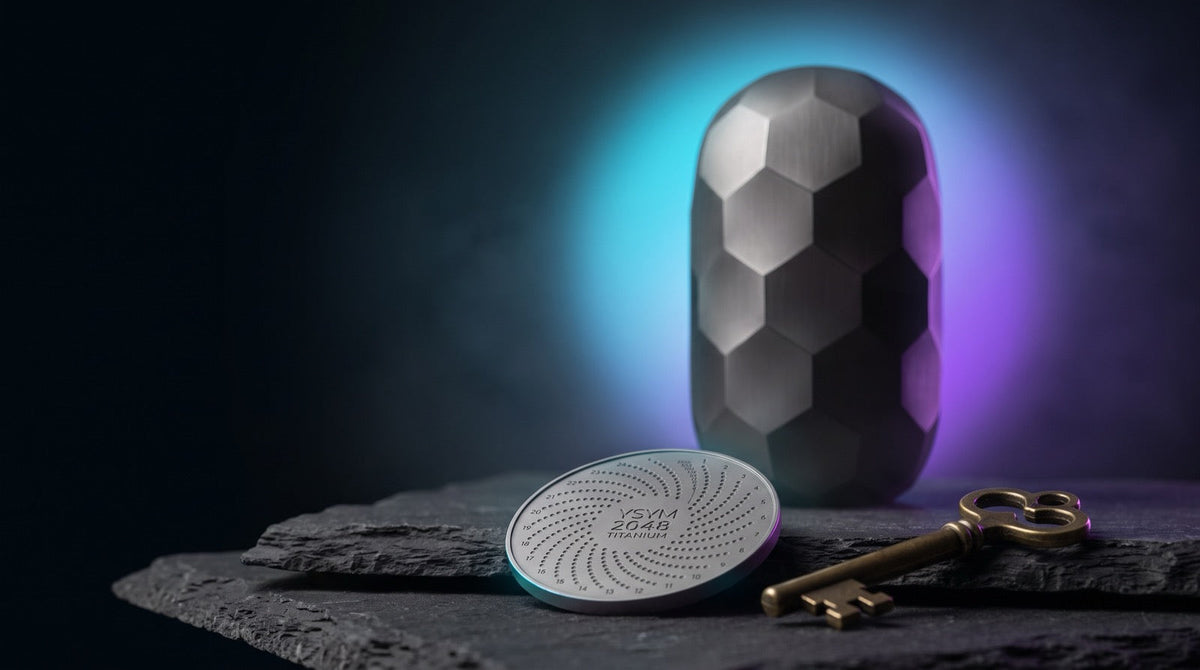
- The analogue piece: the seed phrase, engraved on a Yoseyomo. A piece of metal, never connected to the internet, where the seed phrase is engraved and that lasts far longer than paper. Whoever finds it only reaches the decoy wallet.
- The digital piece: the passphrase and where the Yoseyomo is, in an Inheritans message. In that message you write the passphrase and describe where the Yoseyomo is kept without giving the exact address, using a reference only your family will understand: "it's at Aunt Paquita's, on the pantry shelf". Inheritans encrypts the message on your device before sending it and delivers it only to the person you choose, and only when the time comes: after checking your death with the documents your trusted contacts provide or, if you stop logging in for the period you choose, after trying to reach you first.
While you are alive, nobody holds full access to your funds on their own, and when the time comes your family receives exactly the piece it is missing. That is sovereignty: your crypto stays yours until the end, and then goes to whoever you decided.
A real case: the passphrase as a second lock
We saw it first-hand in 2026. Coinkite, the maker of Coldcard wallets, published a security advisory: for years, several models had generated seed phrases with far less randomness than they should (about 72 bits instead of 128 on the Mk4, Mk5 and Q, and much less on Mk3 devices used without dice rolls), and there were multi-million-dollar thefts. One of our customers had an affected Coldcard: in practice, his seed phrase was no longer secret. But his capital sat in the passphrase-protected wallet, and that piece was neither on the device nor within anyone's reach. His wallet was not emptied. He moved the funds to a new seed phrase generated with the fixed firmware, as the advisory recommended.
The advisory is clear on this: a strong passphrase is an independent barrier, but a short, common or reused one can be guessed. A passphrase is not just for inheritance: it is your second lock.
Two warnings:
- If the passphrase is lost, wallet B is unrecoverable. Use the same message to leave clear instructions on how to combine the two pieces.
- Test the restore: check that the recorded seed phrase and passphrase lead to the right wallet.
Want to set this up? Activity checks and verified delivery are included in the paid Inheritans plans. Lattice (€199.99/year) adds unlimited messages, so each person gets their own, and the recipient recovery and assistance service, which supports your family through the process. See the Inheritans plans.
The inventory every holder should leave
No secrets inside, just the map:
- Which exchanges you use and the email you signed up with.
- Which self-custody wallets you hold and of what type (hardware, multisig…).
- Where the access instructions are and who can open them.
- Who will help your heirs with the technical side: a trusted person or, if your Inheritans plan includes it, its assistance service.
- The date of the last review.
This inventory can go in the same Inheritans message, or in a separate one for each person.
What mistakes cause crypto to be lost in an inheritance?
- Telling nobody. A common and serious one: heirs never learn the crypto exists.
- Keeping the seed phrase in digital form: photo, cloud, email, phone note or password manager.
- Putting the seed phrase in the will.
- Using a passphrase and not passing it on. The seed phrase opens an empty wallet and the family assumes there was nothing.
- Keeping everything in one place that anyone entering the house can reach.
- Leaving no technical instructions: which wallet, which network, which multisig setup.
- Never updating the plan when wallets, exchanges or heirs change.
- Ignoring tax deadlines, which can trigger surcharges and interest.
The cost of keeping everything together
We told this story in the real case of Manuel: he kept his Ledger and his seed phrase in the same box, lost the box, and today he can see his balance in the app but cannot move anything. Had the seed phrase been engraved in metal and kept somewhere else, losing the Ledger would have meant losing nothing more than a gadget.
What steps should holders and heirs follow? A 10-point checklist
If you are the holder:
- Make a will and mention your crypto assets (no secrets).
- Engrave your seed phrase on a physical backup and remove any digital copy from your devices.
- Send the passphrase and where the seed phrase is by another route, one that only reaches your family when the time comes.
- Test the restore and review the plan once a year.
- Make sure someone helps your family with the technical side: a trusted person or the Inheritans recipient recovery and assistance service (Plus and Lattice plans), which supports whoever receives your message.
If you are the heir:
- Get the death certificate and find out whether there is a will.
- Obtain the document that proves who inherits.
- Locate exchanges and wallets; never share a seed phrase.
- Record values at the date of death and check local tax deadlines.
- Ask a tax adviser about reporting duties and future sales.
Related questions
Can cryptocurrency be inherited? Yes. It is part of the estate. The obstacle is technical: without the seed phrase (and passphrase, if any) heirs own the crypto but cannot reach it.
Do heirs pay tax on inherited crypto? It depends on the country: inheritance tax, estate tax or neither. Valuation is usually tied to the date of death.
Should I put my seed phrase in my will? No. State that crypto exists and where the instructions are. The seed phrase is kept separately, on a physical backup, never in digital form.
Can an exchange transfer a deceased user's crypto to the heirs? Yes, with estate documents. Each platform has its own process.
What happens if the heir has the seed phrase but not the passphrase? They will open a different, usually empty wallet. Without the passphrase, those funds are unrecoverable.
Share:
What Happens to Your Crypto If You Die Without Leaving Your Seed Phrase
What Happens to Your Crypto If You Die Without Leaving Your Seed Phrase